Sunday, December 10, 2017
Music and Physical Activity
Do you have your own separate playlist for when you go to the gym or your morning run? Do you listen to something hard-core or lightly fast-paced? Studies show that when warming up for any exercise, you should listen to something around the 80-90 beats per minute range. As it turns out, the more fast-paced music you listen to, the faster your heart rate may beat, because it keeps you from getting fatigued, and keeps you alert. However, when you are in your peak of the workout, say in running, you can listen to about 120 to 140 BPM. The one criticism to these practices when exercising is the music volume you are putting into your ears; it is safe to say that if you constantly have your iPod up from day to day, you will damage your ears! The researchers recommend that you can listen the a few songs to a high volume when you're exercising, but you should lower the volume most of the time to reduce the chances of damage to your hearings. Also, don't listen to loud music with earbuds or headphones for a few days after this high volume exposure. However, I'm sure that since a lot of people exercise everyday, moderation is key when it comes to volume. So, knowing this, do these songs fit your exercise regimen playlist? https://www.webmd.com/fitness-exercise/features/exercise-and-music#2
Music and Nostalgia
I think we all have those wonderful moments that we experience when we listen to music, and we think "oh, I remember when this first came out!" This nostalgic emotion makes us feel happy, and even sad at times, because I think we realize how much we are growing and how good times were "back in the day". This is because our most special "first time" moments happen when we typically listen to music, because music makes us feel good! Just had your first kiss? Might as well turn up the Taylor Swift in the car and remember this moment forever! It sort of makes sense when we realize that we still do it today. Just had your first horrible break up? Sit alone with your Ben & Jerry's and listen to some Secondhand Serenade, or maybe Kelly Clarkson. If on the rebel side of breakups, turn up the Carrie Underwood and bring your "Louisville slugger to both headlights".
Don't believe me-- listen to this video, and see if there are any songs that you can reminisce about!
Monday, December 4, 2017
Music or Misconception?
Have you ever experienced a break up, a family split, a dying loved one, or just a bad day? Follow up question, have you listened to sad, melancholy music to make you feel better? If you have, trust me, you're not the only one. You listen to the blues, Secondhand Serenade, and maybe even Johnny Cash. You sang every word and sat there thinking about how the singer feels just as bad as you. You cry a bit, too. After you're done, you feel a small weight has lifted off your shoulders, and you can breathe a bit easier. Why does this happen? In the last post, I explained how the amygdala in the gray matter of your brain controls emotion expression and emotional memories. Even so, in this article in the Huffington Post, they disregard this scientific assumption for another one. A study with a sample of 220 participants all got asked the same request: think about a particularly sad event in your life, and what sad music did you listen to and why. Dr. Annemieke van den Tol told the Post, "We found in our research that people's music choice is linked to the individual's own expectations for listening to music and its effects on them" (Patel, 2014). This is explained as though people who listen to sad music first think about their situation as the begin the music. Thus, the effects are subconsciously self-induced, with your brain being the culprit behind the curtain. They also found that this experience "had a negative impact on creating a better mood" (Patel, 2014). Thus, this had no real benefit whatsoever to the listener. This does not mean that the music doesn't play a part; the "value", one would call it, of the music depended on the listener, and made it to feel like it truly did something. However, this is just one study, and many people believe otherwise. But what do you believe?
Sources: Patel, A. (2014, February 24). Music And Health: Do Sad Songs Actually Make Us Happier? Retrieved December 04, 2017, from http://www.huffingtonpost.ca/2014/02/24/music-and-health_n_4847373.html
Music and The Brain
Ever wonder why music affects us so much? Or how? Well, here are some answers in short. The brain can do so many things-- we don't always understand it all either. What we do know is there are different parts of the brain that control and do different things. For example, the prefrontal cortex is involved in behavior and decision-making; the amygdala controls certain emotions, that including fear. However, the amygdala is one of the big components of feeling sadness, joy, anger, or angst with music. The amygdala also plays a part in emotional memory; this memory is a type triggered by positive or negative feelings, and this contributed to the feelings from listening to music. So, this is a reason why so many people believe that listening to music while studying helps the student do so much better on tests, homework, etc.
Here is an interesting read to anyone who would like to learn more in-depth information on the brain's interpretations of music. http://serendip.brynmawr.edu/bb/neuro/neuro99/web1/Sancar.html
Sources:
https://rampages.us/jethrosmitty/wp-content/uploads/sites/12942/2015/11/Brain-on-music.jpg
http://scholarpedia.org/article/Amygdala
Thursday, November 9, 2017
Vector Graphics Tuned In Logo
Here above are logos specifically for this blog, Tuned In, made by me using a program called Method Draw. It is a bit more of a simple program, compared to other ones I have seen, but it worked well for this assignment. My first image is of a heart and headphones; the whole meaning to my blog is to offer information on what effect music can have on people, physically and mentally. Thus, the heart represents how music can emotionally effect us, and the music is represented through the headphones.
As for the other logo, it is a little more verbal, and a little more to decipher. Between two mirrored Alto clef symbols (one of the clefs used to symbolize for notes and key) is the initials of my blog title, Tuned In. Again, this is to be more direct with the logo, but the initials along with the intricate design of the clef, it seems more elegant and more attractive. I like this one better than the other, but the emotional meaning of what my blog represents is not truly displayed in this logo.
Wednesday, November 1, 2017
Textorizer Photos
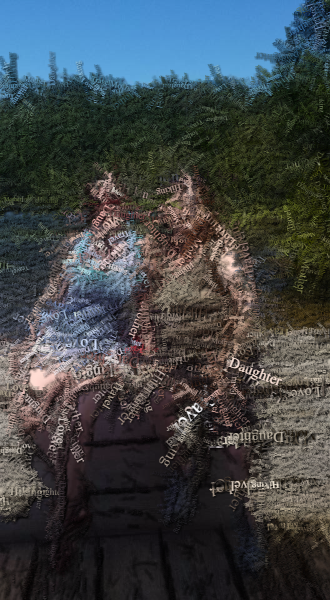
The three top photos are my original pictures taken, and the three lower photos are edited through the program Textorizer. The first photo is of me and my mother when we had gone up north for the weekend to go exploring local attractions, and it was an amazing time. This photo I altered in Textorizer 1, using many words overlapping each other but still conveying a message. I found this to be the most difficult out of the three edits, because I had to get it just right to read some of the words, but see what the image is. The faces are a little hard to see, but the art of it is not to be completely perfect like the original. The second image is the star of my photo inspiration-- my dog Zeus. This photo is an already black and white representation of him sitting and looking over the lake, where we live. The edited image is the Excoffizer version of this, and it is a good chose, because it does make the viewer feel as if their eyes are "vibrating" while looking at it, especially up close. Lastly, my third photo is also of Zeus, but a up-close portrait type. I chose to edit this in Textorizer 2, overlapping the photo with words and sayings describing the photo. In this case, I chose to use a saying to describe the great things about dogs and their love and loyalty. Overall, I really liked using this program, but it was still difficult for me to find the best image to use to be seen and understood by the viewer. I hope you enjoy!
Tagxedo Photo
This is a photo of me transformed in the Tagxedo application, which use words as the figure or shape you choose. I always liked the portraits used with their words describing them or what they are representing. So, I decided I wanted to choose words that I would like to describe myself or something that I would like to be. However, I found this program to be quite frustrating to use when choosing a picture as well as editing it enough to be fully recognizable when the words just fill the shape. Also, I wish there had been more options to use to possibly make it more personalized for every picture. Never the less, I am quite proud of this image, for I think it was executed successfully. I hope you enjoy!
Subscribe to:
Posts (Atom)
Digital Media Course Final Reflection
This music-inspired blog is also the blog used for my Digital Media class, and as such, I will be dedicating a post reflecting my growth an...

-
The above pictures are edited photos of the originals, also posted. In attempting to create an ASCII, or American Standard Code for Informa...
-
Do you have your own separate playlist for when you go to the gym or your morning run? Do you listen to something hard-core or lightly fast...
-
Hello all- here is my production of my song and video mashup! So first off, my song has a variety of melodies and feels to it, and i wante...